
Barrett's Esophagus
A change in the lining of the lower esophagus from chronic acid reflux. Most patients never develop cancer but require regular surveillance endoscopies.
Category
Chronic
Red flags
3
This article is educational and does not replace your doctor's advice. Seek urgent care for any red-flag symptoms.
What is it?
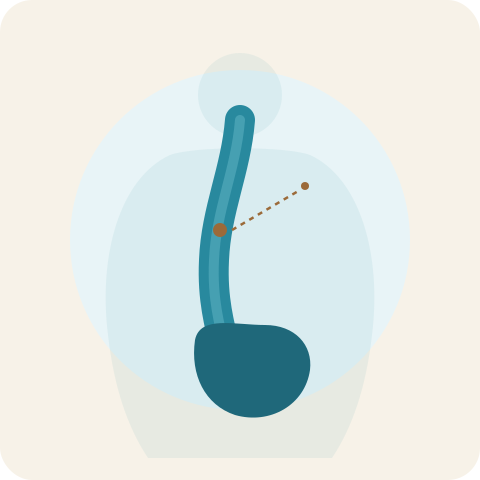
Barrett's esophagus is when the normal esophageal lining changes to a different type of cell that resembles intestinal lining. This happens because of long-term acid exposure from GERD. Barrett's itself causes no symptoms — but it is a small risk factor for esophageal cancer (adenocarcinoma).
How common is it?
Found in 5–10% of adults with chronic GERD. Risk factors: white men over 50, obesity (especially abdominal), smoking, family history of Barrett's or esophageal cancer.
Why does it happen?
Years of stomach acid bathing the lower esophagus damage the normal squamous cells. Over time, the body replaces them with intestinal-type columnar cells — a protective adaptation, but one that has slightly higher cancer risk.
Symptoms
- No symptoms from Barrett's itself
- Symptoms come from underlying GERD: heartburn, regurgitation, sometimes none ("silent reflux")
Red flags — seek urgent medical care
New difficulty swallowing or food sticking
Could indicate cancer or stricture — needs prompt endoscopy.
Unexplained weight loss
Always investigate.
Vomiting blood or black stools
Emergency department.
How is it diagnosed?
Diagnosis requires upper endoscopy with biopsies. The doctor sees orange-pink tongues of tissue extending up from the stomach into the esophagus. Biopsies confirm intestinal cells. Length of Barrett's is measured (short segment <3 cm vs long segment ≥3 cm).
What the latest science says
Cryotherapy and radiofrequency ablation (RFA) can erase Barrett's esophagus and dramatically reduce cancer risk. These are now standard for Barrett's with dysplasia.
Outlook — what to expect
Excellent in non-dysplastic Barrett's — annual cancer risk under 0.3%. With low-grade dysplasia: 1% per year. With high-grade dysplasia: 5–10% per year — but ablation now reduces this dramatically.
Treatment
Habits & Lifestyle
Aggressive GERD control prevents progression.
- Lose weight if overweight.
- Avoid late-night eating; raise the head of the bed.
- Stop smoking — doubles cancer risk in Barrett's.
Diet
A Mediterranean diet is associated with lower progression risk.
- Plenty of vegetables, fruits, whole grains, fish.
- Limit red and processed meats.
- Avoid alcohol — increases cancer risk.
Medications
Lifelong PPI is recommended for Barrett's.
- PPI (omeprazole, pantoprazole, or esomeprazole) once daily — keeps acid off the Barrett's segment.
- Aspirin (low-dose) — observational data suggest reduced cancer risk, but only consider if cardiovascular indication exists.
Procedures & Surgery
Surveillance endoscopy is the cornerstone — early detection of dysplasia means cure.
- Surveillance endoscopy every 3–5 years if no dysplasia; every 6–12 months if low-grade dysplasia; ablation if high-grade.
- Endoscopic mucosal resection (EMR) for visible nodules.
- Radiofrequency ablation (RFA) for dysplastic Barrett's — burns the abnormal tissue away.
Questions to ask your doctor
Save this list or print it before your appointment — doctors appreciate prepared patients.
- How often do I need surveillance endoscopy?
- Should I be on aspirin for cancer prevention?
- Am I a candidate for ablation?
Medically reviewed by: SGA Patient Education Panel · Last reviewed 24/04/2026