
Achalasia
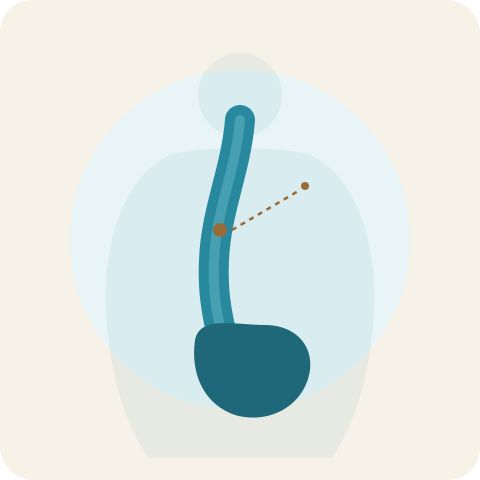
A condition where food cannot pass easily into the stomach because the lower esophageal muscle does not relax. Treated with endoscopic procedures (POEM, balloon dilation) or surgery.
Category
Chronic
Red flags
2
This article is educational and does not replace your doctor's advice. Seek urgent care for any red-flag symptoms.
What is it?
In achalasia, the nerve cells that control the lower esophageal sphincter (the valve between esophagus and stomach) progressively die. The valve stays tightly closed, food and liquid get trapped above it, and the esophagus dilates over years. The exact cause is unknown — possibly autoimmune.
How common is it?
Rare — about 1 in 100,000 adults per year. Equally common in men and women, usually diagnosed between 30 and 60 years old.
Why does it happen?
Loss of inhibitory neurons in the esophageal nerve plexus. Likely autoimmune in most cases. In some parts of South America, Chagas disease causes a similar condition; this is not a concern in Saudi Arabia.
Symptoms
- Difficulty swallowing — usually solids AND liquids equally (key clue)
- Regurgitation of undigested food, especially when lying down
- Chest pain, often after eating
- Slow weight loss
- Persistent cough or pneumonia from aspirated food
Red flags — seek urgent medical care
Sudden complete inability to swallow saliva
Food bolus stuck — emergency endoscopy.
Aspiration with shortness of breath or fever
Aspiration pneumonia possible — seek care urgently.
How is it diagnosed?
Esophageal manometry is the gold standard — it measures pressure patterns in the esophagus. Barium swallow shows the classic "bird-beak" narrowing at the bottom of the esophagus. Endoscopy rules out cancer mimicking achalasia ("pseudoachalasia").
Outlook — what to expect
Highly treatable with modern techniques. Most patients eat normally after a single procedure. Untreated achalasia leads to severe weight loss, repeated lung infections, and a small (1–4%) lifetime risk of esophageal cancer.
Treatment
Habits & Lifestyle
Until treatment, simple measures help.
- Eat slowly, chew very thoroughly.
- Drink warm water with meals to help food pass.
- Sit upright for 1–2 hours after eating.
- Sleep with head of bed elevated to prevent regurgitation aspiration.
Diet
Soft foods are easier to swallow.
- Soups, stews, mashed dishes pass more easily than dense breads or tough meats.
- Avoid alcohol — relaxes the esophagus inappropriately.
Medications
Medications are second-line — they only modestly help symptoms and have side effects.
- Calcium channel blockers (nifedipine) sublingually before meals — modest effect.
- Botulinum toxin injection at the LES — works for 6 months on average; useful for elderly or surgical candidates with poor function.
Procedures & Surgery
Definitive treatments are excellent and durable.
- POEM (peroral endoscopic myotomy) — newest, most effective; cuts the muscle from inside the esophagus through an endoscope. 90% effective.
- Pneumatic balloon dilation — stretches the LES; may need repeating; 70-80% success.
- Heller myotomy (laparoscopic surgery) — traditional surgical approach with anti-reflux wrap. Excellent long-term results.
In the Saudi context
POEM is performed at several Saudi tertiary centers (KFSH, KFMC, KAMC). Insurance typically covers all three modalities. Esophageal manometry is widely available.
Questions to ask your doctor
Save this list or print it before your appointment — doctors appreciate prepared patients.
- Which treatment is best for me — POEM, balloon, or surgery?
- What is my risk of needing a second treatment later?
- Should I have surveillance endoscopy for cancer risk?
Medically reviewed by: SGA Patient Education Panel · Last reviewed 24/04/2026